Emotional Intelligence
77% of European recruiters favor emotionally intelligent candidates rather than those with many diplomas.
Emotions color our lives with their many colors; they are “the colors of the world”, sometimes luminous or dark, sometimes bright or deep. They influence our perception of circumstances and are fundamental to the relationship with our children, family and colleagues, but also to our connection to nature, other nations and cultures. They are often sources of conflict, hardship and suffering; but they are also the vibrant expression of the heart, of deeper feelings like friendship, love and compassion.What is emotional intelligence?
Emotional intelligence refers to “the ability to perceive and express emotion, assimilate emotion in thought, understand and reason with emotion, and regulate emotion in the self and others”. We can see that the world is evolving rapidly; emotional maturity and personal development are becoming a priority for many, because which changes (social, ecological, political or economic) can profoundly improve the human condition if there is no prior transformation of the individual? Even at the professional level, it appears in many surveys that more than three-quarters of recruiters favor emotionally intelligent candidates rather than those with many diplomas. Emotional intelligence is now considered to be just as important as intelligence quotient (IQ).Exercises
A prerequisite for progress is self-knowledge: becoming aware of our emotions, thoughts, reactions, strengths and weaknesses, but also of this presence that moves us – our profound essence. This awareness is progressive; the adult, to encourage it in the child, can simply give him a mirror, get him used to taking his “inner weather”, observing himself, turning his gaze inwards. The child will be lead to discover the warning signs of a storm, the causes or circumstances that provoke it, its effects on his body, behavior, thoughts and emotions.Sit comfortably and take a few moments to observe your inner weather: how do you feel physically (tension, relaxation, etc.), emotionally (sad, agitated, etc.) and mentally (many or few thoughts, etc.)? Simply take note of these feelings. Now, breathing through the nose if possible, feel your diaphragm come down and swell the abdomen while inhaling; while exhaling, the air exits through the nostrils and the diaphragm rises. For this breathing to be even deeper, you can feel the region from your lower abdomen up to the pubis also rise and fall to the rhythm of your breathing. Now return to your inner weather and observe physical, emotional and mental changes.
Character Strengths
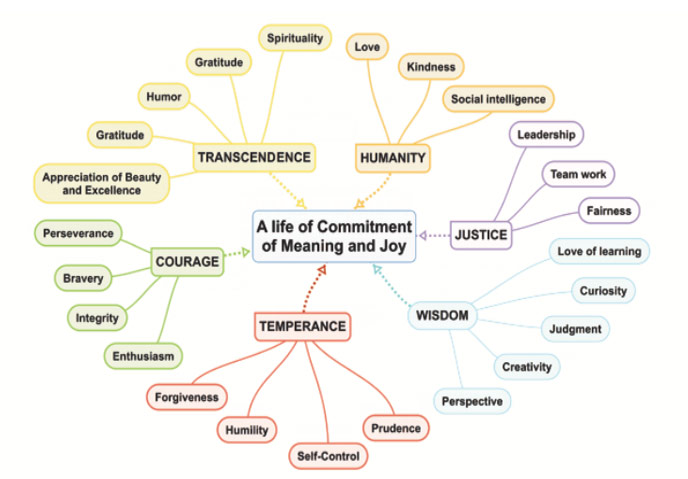
For several years in positive psychology, character strengths have been studied with the aim of classifying the positive traits of the human being. Martin Seligman and Christopher Peterson have established a reference framework for these strengths, proposing a classification of 24 strengths of character that are constantly cited across different cultures, grouped under 6 virtues. The listed strengths are universal. This classification aims to promote the identification of the individual’s resources, allowing him to achieve well-being.Here is the link to discover your five intrinsic qualities : the VIA test.
After handing over the questionnaire, we obtain a ranking of our main strengths. The first 5 are what the authors call the individual’s “signature”. According to the approach proposed by positive psychology, making use of these personal forces – especially those which constitute the signature – is a source of progress and well-being. Like the child who loves to walk and run once she or he has learned this skill, we enjoy doing activities in which our abilities, skills and talents are used, throughout our lives.Several programs for schools have been established on this basis so that students can discover and develop their intrinsic strengths of character and increase their resilience as well as the frequency of positive emotions. Studies have shown that students who followed these programs had an increased curiosity, creativity and social fiber (empathy, cooperation, self-control, insurance); they had also developed a passion for learning, commitment and pleasure to be in school; depression and anxiety were reduced while academic performance improved as well.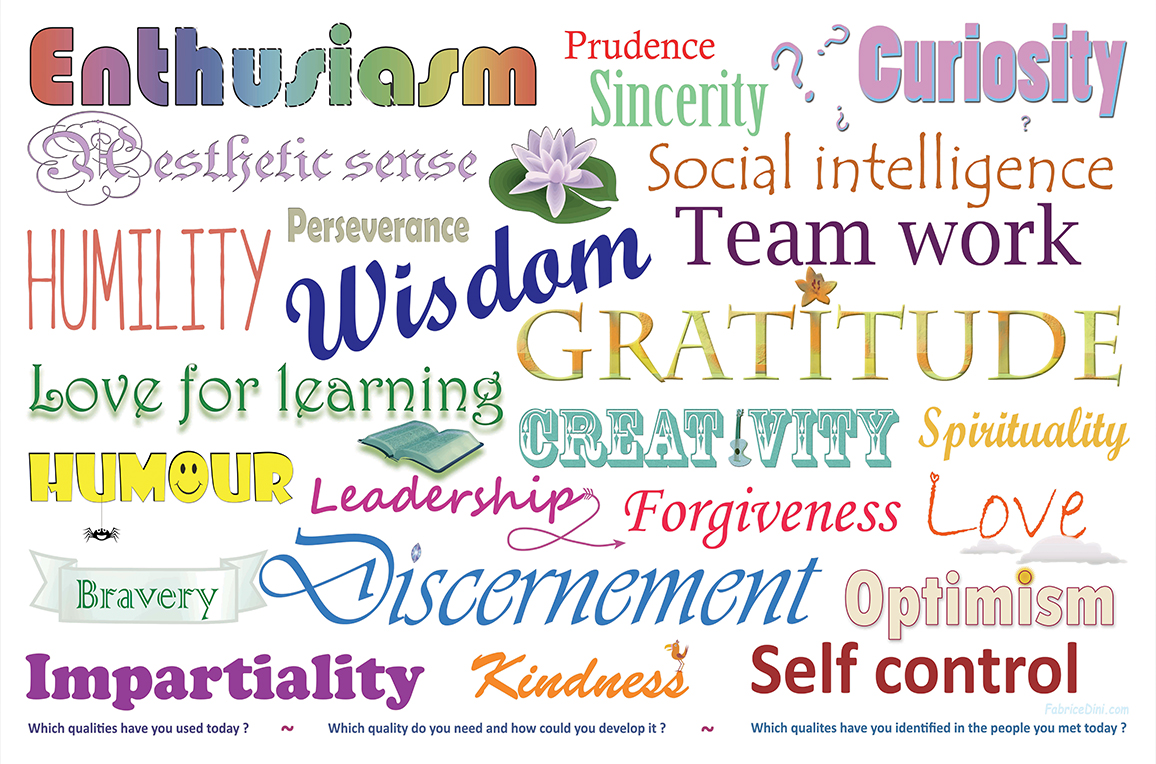
Exploring a strength of character
What is your definition of this strength? Make a list of the situations or circumstances (with whom, when) in which it is present. Does it bring you anything? How do you feel when it is present (physically, emotionally, in your head)?Strategies for developing character strengths
Think of seven new ways to use one of your strengths (in the daily, professional, social, and sentimental aspects of your life; to make classes more interesting in school, with regard to the relationship with your parents, brother or sister, and friends, during your free time or when doing sports). Example of curiosity: deepen my knowledge of a theme that I am passionate about by reading books, specialized journals, doing research on the Internet, watching a documentary; observe the architecture of buildings on the way to school; try to understand my brother’s character; observe fluctuations in my mood during the day; take courses on a subject I do not know; regularly spend time with people from a different culture to discover their culture’s richness; explore the fauna and flora of the forest at least one hour a week.Managing difficult situations with our strengths of character
Think of a recent and somewhat difficult situation. Review each of your 5 principal core strengths and explore how they can help you deal with the situation better; find one or more strategies. For example, if one of my strengths is humor and I have tensions with someone, I can break the ice with humor to relax the atmosphere and establish some complicity. If it always takes ten minutes to make teams during recess, I can use my quality of leadership to speed it up. You will find many other exercises to cultivate the strengths of character in the book.